
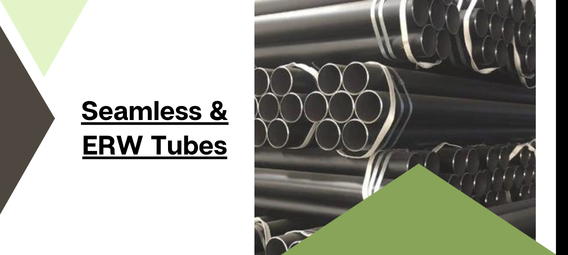
Industrial Steel Tubes
Steel tubes are at the base of modern engineering and construction. From pressure lines to load-bearing frames, these tubes provide support for systems that require strength, safety, and long service life. Among various alternatives available, seamless and ERW tubes are the most commonly used. Each type has a unique production path that determines its strength, pressure limits, pricing, and use cases. Understanding these differences helps in avoiding failure, downtime, and safety hazards in crucial projects. This blog discusses how seamless and ERW tubes are manufactured, how they perform under stress, and where each is most suited. It also examines cost, availability, and selection criteria to help users make informed selections in industrial applications.
What Are Seamless Tubes?
Seamless tubes are steel tubes made without any welded joint. They start as solid steel billets, which are heated and pierced to form a hollow shape. This hollow shell then goes through hot rolling, cold rolling, or cold drawing to reach the required size and wall thickness. As no weld seam exists, the tube has uniform strength around its full circumference. This structure lowers the risk of weak points under pressure or heat. Seamless tubes handle high stress, high pressure, and wide temperature changes with ease. Common materials include carbon steel, alloy steel, and stainless steel. Depending on how they are used, these tubes meet standards set by ASTM, ASME, and API. Customers generally choose seamless tubes when safety margins need to be maintained high and failure is not an option.
What Are ERW Tubes?
Electric Resistance Welded (ERW) tubes begin as flat steel strips known as “skelp,” which are cold-formed into a cylindrical shape with a series of rollers. When the edges connect, a high-frequency electric current travels across them, generating heat and fusing the metal without the need for filler material. This process produces a smooth, straight longitudinal seam along the length of the tube. Following welding, the tube is often heated to enhance the weld zone and make it as strong as the structure. As the initial material is a precisely rolled flat sheet, ERW tubes have excellent dimensional accuracy and consistent wall thickness. These tubes provide a reliable and cost-effective solution for a wide range of structural and mechanical requirements across various industries.
Manufacturing Process Comparison
The key difference between these two products is in how they emerged as raw materials. Seamless tubes require a solid billet and a heavy-duty pierce machine, which makes the manufacturing process energy-intensive and complicated. ERW tubes, on the other hand, are made from hot-rolled steel coils, allowing for a faster and more scalable manufacturing process. Quality control for ERW is largely focused on the weld’s integrity, with ultrasonic or hydrostatic testing often used to ensure a flawless seam. Seamless production eliminates the welding variable entirely, but it requires meticulous examination for wall thickness consistency. While ERW is less expensive and easier to make in large quantities, the seamless method is required to create very thick-walled tubes that welding equipment cannot efficiently handle.
Strength and Mechanical Performance Differences
Strength and pressure-handling capabilities set seamless tubes apart from welded options. Because a seamless tube is a single piece of metal, it lacks the “weak link” that a weld seam might represent under extreme pressure. This makes them the standard choice for high-temperature and high-pressure environments where a failure could be catastrophic. Seamless tubes are more resistant to fatigue, and impact as their metallurgical structure remains continuous throughout. While current ERW tubes are extremely strong with excellent reliability welds, as they are rated to lower operating pressures than seamless counterparts. In applications involving significant torsion or internal stress, the uniformity of seamless tubing gives a better safety margin and reduces the risk of the tube splitting along a seam line.
Dimensional Accuracy and Surface Finish
ERW tubes often surpass other materials in terms of precision. As they are formed out of flat-rolled steel, the wall thickness is uniform over the entire diameter. This results in good roundness and tight tolerances, which are critical for automobile parts or machinery where components must fit together correctly. The hot-piercing method might cause minor changes in wall thickness or a harsher surface quality in seamless tubes. While cold-drawing can improve the surface of seamless pipes, ERW is still the best solution for applications that require a smooth exterior and interior without extra machining. For precise manufacturing, where the weight and fit of the tube must be exact, ERW’s dimensional reliability is an important benefit for both producers and builders.
Applications of Seamless & ERW Tubes
The type of tubing used is entirely determined by the requirements of the system. Seamless tubes are widely used in the oil and gas industry, high-pressure boilers, and chemical processing plants, where safety and leak prevention are critical. Their ability to endure heat and chemicals makes them important in heavy industry. In contrast, ERW tubes are often used in the construction of buildings, furniture, and vehicle frames. They are also commonly used in low-pressure fluid transport applications, like water pipelines and scaffolding. Choosing the right tube requires a balance between the environmental conditions and the mechanical requirements of the project. While Seamless performs well in heavy lifting in extreme areas, ERW serves as the structural foundation for most everyday infrastructure and industry needs.
Cost, Availability, and Selection Factors
Budget and market availability are key factors in the final selection of steel tubes. Seamless tubes are often more expensive, as the production process takes a longer period and requires more specialized equipment. They also require longer lead periods, depending on the grade and size. Due to the welding process’s effectiveness, ERW tubes are significantly less expensive and more commonly accessible in various diameters. For applications with limited budgets and standard pressure requirements, ERW is the realistic option. However, project managers must consider long-term costs; using a low-cost ERW tube in a high-pressure system may result in costly repairs or safety issues later. The final decision is generally based on the industry’s unique standards and the material’s value.
Conclusion: Choosing Between Seamless and ERW Tubes
Champak Steel Engg. & Co. helps clients navigate these technical choices to ensure every project stands the test of time. Reach out to us for expert guidance and high-quality steel solutions. Selecting between seamless and ERW tubes requires a clear look at your project’s pressure needs, budget, and precision requirements. Seamless tubes provide the ultimate strength for high-risk, high-pressure environments, while ERW tubes offer cost-efficiency and great dimensional accuracy for structural and low-pressure uses. By weighing the manufacturing differences and mechanical limits of each type, you can make an informed decision that ensures both safety and performance. Always prioritize the specific demands of your application to choose the tube that offers the best long-term reliability for your infrastructure. Contact us today.