
Introduction
Pipe selection affects more than just installation. It impacts pressure handling, repair frequency, and how long the system runs without interruption. In pipeline work, the diameter and operating conditions usually decide the direction early. Cost comes in later, but it still matters.
HSAW Pipes and ERW Pipes are both used across industries, but they are not interchangeable. Both fall under carbon steel welded pipes, yet the manufacturing method changes how they perform. This shows up clearly in Industrial Applications of HSAW Pipes, especially in large transmission lines where size and load conditions are not standard.
What Are HSAW Pipes?
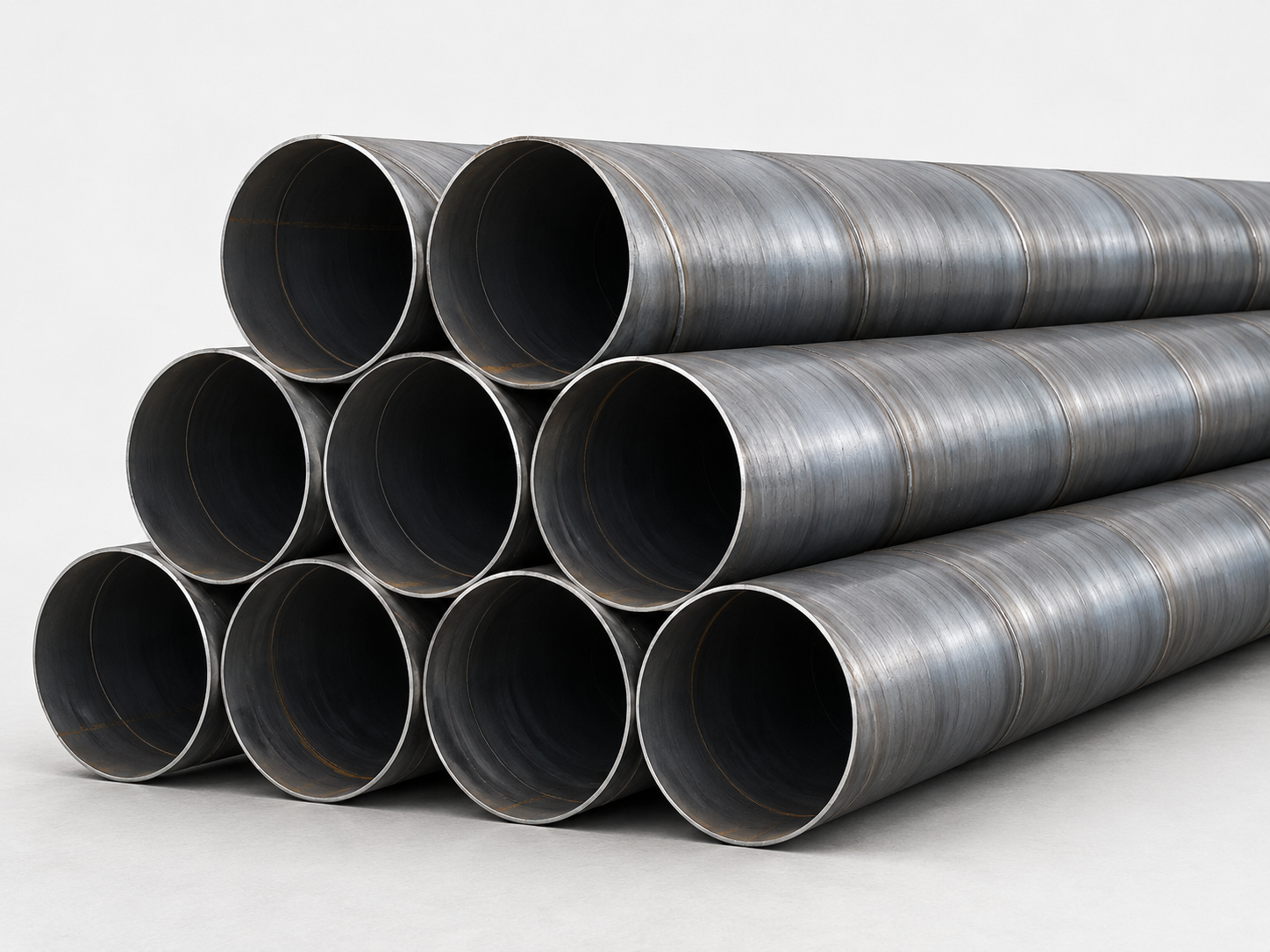
HSAW pipes mean Helical Submerged Arc Welded pipes. These are made by forming steel plates into a spiral and welding along the helical seam using submerged arc welding. The weld runs at an angle. That changes how stress is distributed across the pipe.
This method makes it easier to produce large diameters because it does not depend on wide plates. That is one of the reasons why HSAW Spiral Welded Pipes are used in long-distance pipelines. Size flexibility helps when project requirements are not fixed.
Carbon steel is the usual material. Grade selection depends on pressure, temperature, and exposure. ASTM A671 Carbon Steel HSAW Pipes are often specified for low temperature service or higher pressure conditions. Thickness and length are adjusted based on design, not just standard availability.
What Are ERW Pipes?
ERW pipes stand for Electric Resistance Welded pipes. These are produced by forming a steel strip into a cylindrical shape and joining the edges using electrical resistance. The seam runs straight along the pipe length.
The process is continuous and controlled. Heat and pressure are applied in a narrow zone, so the weld stays consistent. This results in uniform wall thickness and better dimensional accuracy.
Carbon steel is common here as well. These pipes are used in structural work, automotive components, and general engineering. Where straightness and tight tolerance matter, ERW Pipes are usually preferred. Fabrication becomes easier in most cases.
Key Differences Between HSAW Pipes and ERW Pipes
The difference comes down to how they are made and where they are used. Size, cost, and performance all shift based on that.
Manufacturing Process
Steel plates are formed into a spiral and welded using submerged arc welding in HSAW Pipes, creating a helical seam. ERW Pipes are formed from strips and welded longitudinally using electrical resistance with controlled pressure.
Diameter Range
For larger sizes, HSAW pipes suit better because coiling enables adaptation to common steel plates. ERW Pipes are limited to small and medium diameters due to strip width and forming limitations.
Strength & Performance
HSAW pipes are preferred for heavy-duty use because they handle high external loads and pressure changes well. ERW pipes offer uniform strength, making them ideal for precise, consistency-focused applications.
Cost Consideration
For long-distance pipelines, HSAW pipes reduce costs through flexible sizing and material use. ERW pipes are cheaper for smaller sizes because continuous production lowers manufacturing time and cost.
Applications
Oil and gas transmission, water systems, and infrastructure projects use HSAW Pipes. ERW Pipes are found in automotive parts, structural frameworks, and mechanical systems where dimensional accuracy is required.
Advantages of HSAW Pipes
HSAW pipes are ideal for large‑diameter lines used over long distances. Their spiral forming method makes it easy to change sizes with very few restrictions. This helps when project specifications are not standard.
The pipe stays strong even when outside forces and pressure change. This matters most for buried or offshore pipelines, where stress is not even. You can adjust the wall thickness based on how much load the pipe needs to handle.
Cost works out better in larger projects. Producing bigger pipes using spiral welding is more practical compared to straight seam methods. In marine or chemically exposed environments, performance depends on coating and grade selection. An HSAW Pipes Supplier usually provides options based on actual project conditions rather than fixed stock.
Advantages of ERW Pipes
ERW Pipes have a smooth surface, which reduces extra processing during fabrication. This helps in applications where alignment and fitting need to be accurate. Less correction is required during assembly.
Wall thickness stays uniform across the length. That improves consistency during machining and welding. In structural use, this reduces weak points.
Production is faster compared to other welded methods. Large quantities can be manufactured in less time, which helps control cost for smaller sizes. In precision work such as automotive frames or equipment structures, these pipes are easier to handle and fit.
HSAW Pipes Industrial Applications
HSAW Pipes are used where large size, strength, and long service life are needed. These are usually heavy-duty applications with higher load and pressure conditions.
Oil and Gas Pipelines
These pipes move crude oil, natural gas, and refined products over long distances. Their large size allows high flow rates and safe pressure control in long cross-country pipelines.
Water Transmission Systems
These pipes move large amounts of water for cities and industries. Their bigger size keeps the flow steady, making them ideal for irrigation and long-distance water supply lines.
Structural Piling and Foundation Work
These pipes support loads in bridges, ports, and building foundations. Their strength and large diameter spread the weight and help keep the ground stable, even in difficult soil.
Infrastructure and Construction Projects
Large construction projects, such as highways and tunnels, use these pipes where standard sizes do not fit design needs. Size flexibility supports custom structural requirements.
Offshore and Marine Applications
Offshore platforms and marine pipelines rely on these pipes due to pressure handling and exposure resistance. Coating and grade selection play a role in long-term performance under such conditions.
ERW Pipes Industrial Applications
ERW Pipes are used where dimensional accuracy and cost control matter more than size. These are common in fabrication and engineering work.
Automotive Components
These pipes are used in vehicle frames, drive shafts, and various support components. Their consistent dimensions help maintain product quality and minimise variation during manufacturing and assembly.
Mechanical and Engineering Structures
Machinery frames and equipment supports use these pipes due to their uniform thickness. Fabrication becomes easier, and machining time is reduced.
Construction and Scaffolding
Scaffolding systems and temporary structures use these pipes because they are straight and consistent. Assembly and dismantling become simpler.
Furniture Manufacturing
Metal furniture, such as tables and storage units, uses these pipes. Smooth surfaces reduce finishing work and support repeated production.
Low to Medium Pressure Pipelines
Pipelines carrying water, air, and similar fluids at moderate pressure use these pipes. Availability and cost make them suitable for general industrial use.
HSAW Pipes vs ERW Pipes: Which One Should You Choose?
Selection depends on project conditions. For large diameter pipelines and higher pressure systems, HSAW Pipes are usually the better option. They handle load variation and allow flexibility in size. Smaller sizes and precision work usually go towards ERW Pipes. Fabrication is easier and costs are controlled.
Budget is important, but it is not the only factor. Large infrastructure projects usually use HSAW pipes, while smaller fabrication jobs usually use ERW pipes. Before you decide, check the expected pressure, temperature, and environmental conditions.
Conclusion
HSAW Pipes and ERW Pipes are built differently, so they are used differently. One suits large-scale transmission, the other fits precision and smaller structures.
Choosing the correct pipe reduces future issues. Working with a reliable HSAW Pipes Supplier helps match the material and size with actual project needs, which keeps performance stable over time.