
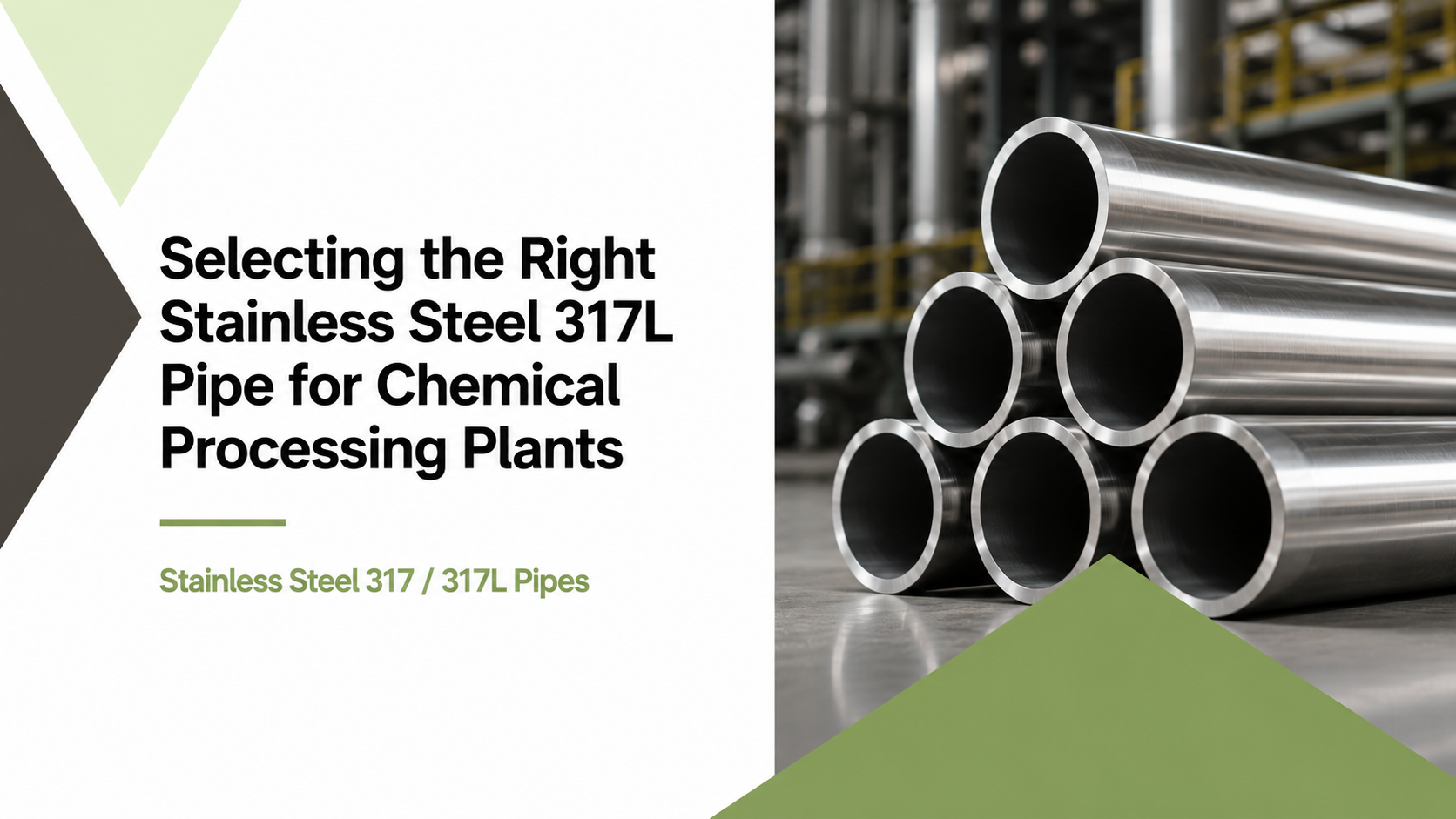
Introduction to High-Performance Industrial Process Piping Systems
Material selection in chemical processing directly affects how long your plant runs without failure. Get it wrong, and you are dealing with premature corrosion, contaminated process streams, and unplanned shutdowns.
Standard grades like 304 or even 316L often fall short in highly corrosive environments. SS 317 and 317L pipes were developed for conditions where 316L starts to show stress corrosion or pitting. The difference lies in the chemistry, and in aggressive chemical service, that difference matters.
Why SS 317/317L is the Preferred Corrosion Resistant Stainless Steel Pipe
Enhanced Chemical Composition and Molybdenum Content
SS 317L contains 3 to 4 percent molybdenum, compared to 2 to 2.5 percent in 316L. That extra molybdenum is not a minor variation. In acidic service, it forms a protective oxide layer that resists chloride attack, sulfuric acid, and other aggressive media.
The higher Mo content directly improves the Pitting Resistance Equivalent Number (PREN). A higher PREN means the material tolerates more aggressive chloride concentrations before pitting begins. Combined with chromium content of 18 to 20 percent, 317L handles mixed acid environments better than standard austenitic grades.
Superior Resistance to Pitting and Crevice Corrosion
Pitting and crevice corrosion are damaging and hard to detect in early stages. By the time they are visible, significant material loss has already occurred.
317L outperforms 316L in both these modes. The passive film is more stable under reducing acid conditions. Where chlorides are present alongside acids, 317L lasts considerably longer before localized corrosion develops. For plants where piping runs are long and replacement is disruptive, this resistance is a key reason to specify 317L.
The Advantage of Low Carbon (317L) in Welded Joints
The “L” stands for low carbon, limited to 0.03 percent maximum. This is critical during welding.
In higher-carbon grades, welding heat causes chromium carbide to form at grain boundaries. This sensitization depletes chromium from surrounding zones, making them vulnerable to intergranular corrosion. 317L avoids this. With carbon held below 0.03 percent, sensitization is essentially eliminated. In chemical plants where welded joints are numerous, this matters significantly.
Critical Applications of Stainless Steel Pipes for Chemical Plants
Handling Aggressive Acids (Sulfuric, Phosphoric, and Acetic)
317L is used extensively in facilities processing sulfuric, phosphoric, and acetic acid. In sulfuric acid service, higher molybdenum content directly lowers corrosion rate at elevated temperatures and concentrations. For phosphoric acid, fluoride contamination from raw materials is a common concern, and 317L handles this better than lower-alloy grades.
Performance in High Temperature Stainless Steel Pipes Environments
317L can be used up to around 870 oC in continuous service. Higher chromium improves oxidation resistance, and molybdenum contributes resistance against sulfur-bearing atmospheres at elevated temperatures. In heat exchangers and process headers that cycle through temperature changes, 317L holds up well.
Role in Petrochemical and Pharmaceutical Processing
317L is used in acid gas scrubbing systems and desulfurization units in petrochemical plants where sulfur compounds, chlorides and high temperatures are present. In pharmaceutical processing it is compatible with aggressive CIP cleaning formulations and will withstand the dilute acids and alkalis used in the cleaning cycles.
Key Factors in Choosing a 317L Stainless Steel Pipe Supplier
Compliance with ASTM A312 and A213 Standards
ASTM A312 covers seamless and welded austenitic pipes for high-temperature and corrosive service. ASTM A213 covers seamless alloy steel tubes for boilers and heat exchangers. Ensure supplier material is fabricated and tested to these standards. Request test reports that specify the particular ASTM designation and verify that the heat chemistry is within the required range for chromium, molybdenum, nickel and carbon.
Quality Assurance and Material Testing Certifications
A reliable supplier will provide mill test certificates (MTCs) that reflect the true chemical and mechanical properties of each lot. Heat number traceability, Hydrostatic test reports, NDT record for seamless pipe and intergranular corrosion test result for L-grade material. Generic certifications are not adequate for chemical plant service.
Customization and Sizing Options
Chemical plants often require specific outside diameters, wall thicknesses, and lengths outside standard catalogue sizes. A capable supplier should cover schedules from SCH 10S to SCH 80S in seamless and welded construction, with custom cut lengths and specific end preparations available. Confirm these capabilities before placing orders.
Conclusion: Optimizing Your Chemical Plant with Grade 317L
SS 317L is a straightforward choice for corrosive chemical service. Higher molybdenum, combined with low carbon for weld integrity, makes it more reliable than 316L in aggressive environments. The material cost difference between the two grades is modest compared to what a premature pipe failure costs in downtime and repairs. For plants processing strong acids, chloride-bearing streams, or high-temperature corrosive media, 317L pays back reliably over the service life of the installation.
Champak Steel & Engg. Co. is a manufacturer and supplier of SS 317 and 317L pipes and fittings for chemical processing, petrochemical and pharmaceutical industries in India and export market. For your project requirements, sizes available and delivery timelines please contact Champak Steel.